

Industrial RO Parts Essential Components of Reverse Osmosis Systems

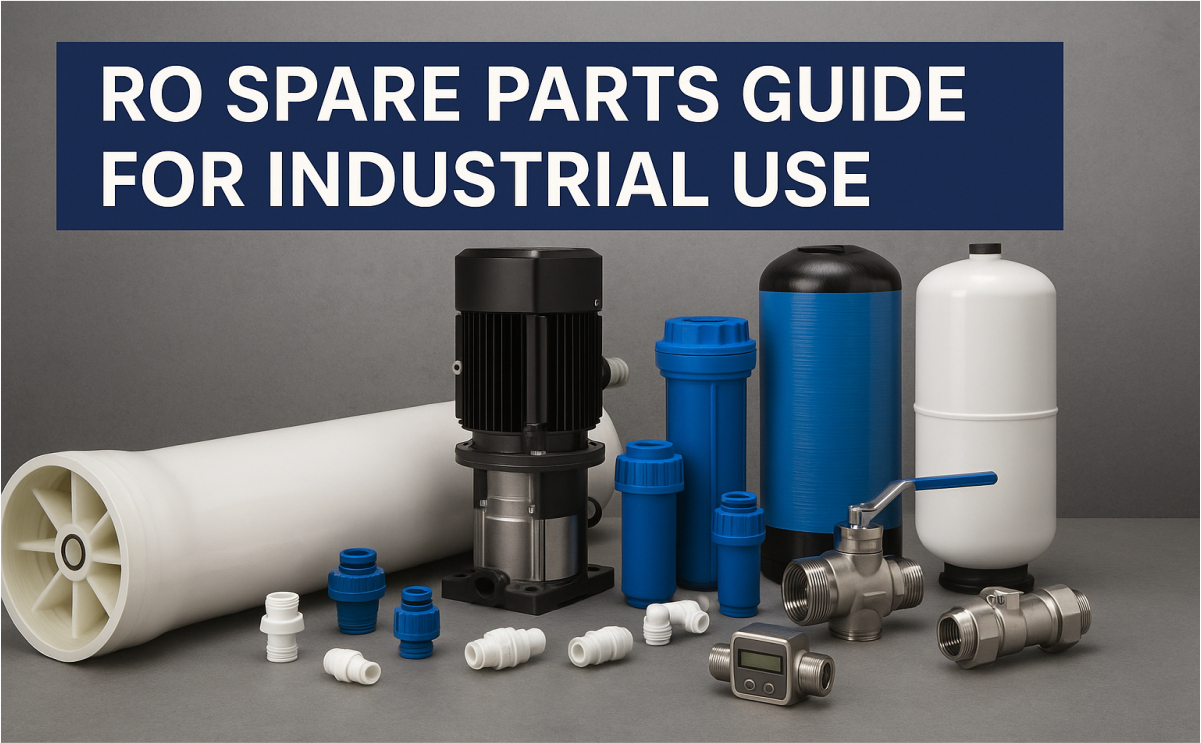
Introduction
Industrial Reverse Osmosis (RO) systems are widely used across various sectors—including manufacturing, pharmaceuticals, food processing, and power generation—to purify large volumes of water. The success and efficiency of any industrial RO plant depend heavily on the quality and functionality of its components or parts.
From pretreatment filters to high-pressure pumps and membranes, each part plays a crucial role in ensuring optimal water quality, system longevity, and operational reliability. Understanding the key industrial RO parts helps in system design, maintenance, troubleshooting, and performance optimization.
Key Industrial RO Parts and Their Functions
1. RO Membranes
-
Function: The heart of any RO system, membranes remove dissolved salts, heavy metals, bacteria, and other impurities.
-
Types: Spiral-wound polyamide membranes are most common in industrial use.
-
Flow Capacity: Ranges from 100 GPD to thousands of GPD.
-
Brands: Dow Filmtec, Hydranautics, Toray, LG Chem.
2. High-Pressure Pump
-
Function: Delivers the required pressure (150–1000 psi) to push water through the RO membrane.
-
Types: Multistage centrifugal pumps or booster pumps.
-
Material: Stainless steel (SS304 or SS316) for durability and corrosion resistance.
3. Pressure Vessels (Membrane Housings)
-
Function: Encases the RO membranes and withstands high operating pressure.
-
Material: FRP (Fiber Reinforced Plastic), Stainless Steel.
-
Sizes: Available in 4″ and 8″ diameters for standard membrane sizes.
4. Pre-Filtration Units
Before water reaches the RO membranes, it must pass through several pretreatment filters to protect the system:
a. Sand/Multimedia Filter
-
Removes suspended solids and turbidity.
b. Activated Carbon Filter
-
Removes chlorine, organic matter, and odor-causing compounds.
c. Micron Cartridge Filter
-
Protects membranes from fine particles (typically 5 or 1 micron).
5. Dosing Pumps & Chemical Dosing Systems
-
Purpose: Inject chemicals such as:
-
Antiscalants – to prevent scale formation.
-
Acid/Alkali – for pH adjustment.
-
Chlorine/De-chlorinators – for microbial control or chlorine neutralization.
-
-
Brands: E Dose, Grundfos, Etatron, LMI.
6. Control Panel / PLC Systems
-
Function: Manages the automated operation of the plant.
-
Includes: Pressure indicators, flow meters, conductivity meters, TDS meters, and PLC (Programmable Logic Controller).
-
Optional: HMI (Human-Machine Interface) for touchscreen operation and remote monitoring.
7. Flow Meters and Pressure Gauges
-
Flow Meters: Monitor water flow through different stages (feed, permeate, reject).
-
Pressure Gauges: Ensure optimal operating pressure across the system and help in diagnosing pressure drops or membrane fouling.
8. Valves
-
Types: Solenoid valves, needle valves, ball valves, NRVs (Non-return valves), and pressure relief valves.
-
Function: Regulate flow, control backpressure, and ensure system safety.
9. Piping and Fittings
-
Material: UPVC, CPVC, HDPE, or SS depending on pressure and chemical resistance needs.
-
Purpose: Connects all system parts and ensures leak-free, smooth flow.
10. UV Sterilizer / Ozonator (Optional)
-
Function: Kills residual bacteria and viruses in permeate water.
-
Application: Useful in industries requiring ultra-pure or microbiologically safe water (e.g., pharma, beverages).
Importance of Using Genuine Industrial RO Parts
-
✅ Performance: Original parts ensure consistent output and membrane protection.
-
✅ Efficiency: Minimize energy and chemical use.
-
✅ Durability: High-quality components last longer under industrial workloads.
-
✅ Compliance: Meets quality and safety standards (e.g., ISO, NSF).
Industries That Rely on Industrial RO Systems
-
Power Plants
-
Chemical Manufacturing
-
Food & Beverage Processing
-
Pharmaceutical & Biotech
-
Textile & Dyeing Units
-
Semiconductor Industry
-
Hospitals & Dialysis Centers
Each of these sectors requires different RO configurations and parts tailored to specific water quality parameters and regulatory standards.
Maintenance Tips
-
Monitor pressure and flow rates regularly to detect membrane fouling or filter clogging.
-
Replace pre-filters and membranes as per manufacturer’s guidelines.
-
Calibrate dosing systems for precise chemical injection.
-
Keep spare parts like O-rings, filter cartridges, and gauges on hand.
-
Schedule periodic service checks and system audits.
Conclusion
Industrial RO systems are complex but highly effective solutions for high-volume water purification. The reliability and efficiency of these systems heavily depend on the quality and compatibility of industrial RO parts. By understanding and sourcing the right components—from membranes to pressure gauges—you ensure uninterrupted operation, water quality compliance, and long-term cost savings.
Investing in genuine, high-performance parts isn’t just good practice—it’s essential for your plant’s success.