

Filters & Housings The Backbone of Water Filtration Systems

Introduction
In any water filtration system—whether for domestic, commercial, or industrial use—filters and housings play a critical role in removing impurities and ensuring clean, safe water. Though often overlooked, these components are the first line of defense in water purification and are essential for the efficiency and longevity of more advanced systems like Reverse Osmosis (RO), UV, or softeners.
Understanding how filters and housings work, and how to choose the right type, is key to maintaining water quality and system performance.
What Are Filters and Housings?
-
Filters are the components responsible for removing contaminants such as sediments, chlorine, organic matter, bacteria, and even dissolved solids depending on the type.
-
Housings are the protective casings that hold the filters in place, ensuring a secure and sealed environment for water to flow through during the purification process.
Together, they form the foundation of pre-treatment in most water purification setups.
Types of Filters
-
Sediment Filters
-
Purpose: Remove physical particles like sand, rust, and dirt.
-
Common Micron Ratings: 1, 5, 10, 20, and 50 microns.
-
Used In: Domestic RO systems, industrial pre-filtration.
-
-
Activated Carbon Filters
-
Purpose: Remove chlorine, organic compounds, bad taste, and odor.
-
Types: Granular Activated Carbon (GAC), Carbon Block.
-
Used In: RO systems, shower filters, and whole-house systems.
-
-
Spun Filters
-
Purpose: Trap suspended solids and fine particles.
-
Structure: Made from polypropylene fibers.
-
Used In: Domestic and commercial filtration setups.
-
-
Pleated Filters
-
Purpose: Provide more surface area for filtration.
-
Reusable: Often washable and reusable.
-
Used In: Higher capacity systems.
-
-
Iron and Heavy Metal Filters
-
Purpose: Remove iron, manganese, and other metals.
-
Used In: Borewell water treatment, industrial processes.
-
-
UF (Ultrafiltration) and Nano Filters
-
Purpose: Remove bacteria and viruses without electricity.
-
Used In: Gravity-based or non-electric water purifiers.
-
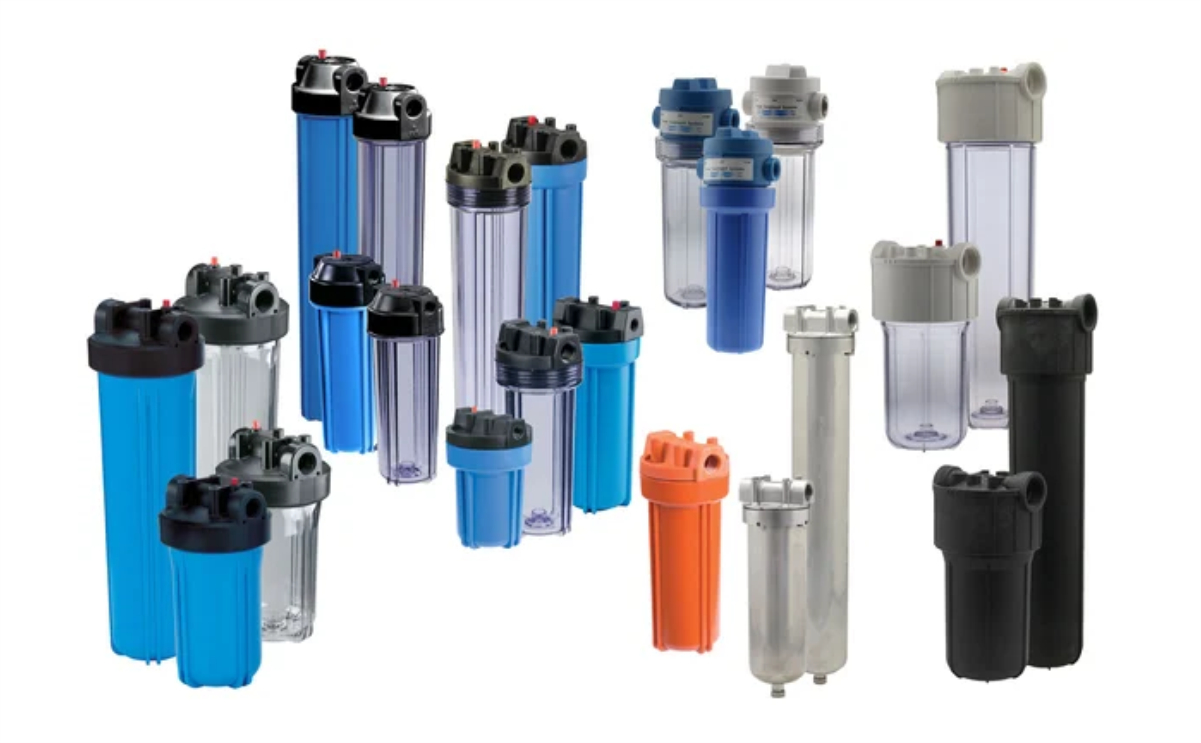
Types of Filter Housings
-
Standard Filter Housings
-
Sizes: Common sizes include 10” and 20” (length).
-
Material: Polypropylene or polycarbonate.
-
Use: Domestic water filters and RO systems.
-
-
Big Blue Housings
-
High Flow Capacity: Ideal for whole-house and commercial applications.
-
Durable Construction: Suitable for high sediment load or heavy-duty use.
-
-
Transparent Housings
-
Easy Monitoring: Allows visual inspection of filter condition.
-
Use: Useful in homes and labs.
-
-
High-Pressure Housings
-
Material: Stainless steel or reinforced plastic.
-
Use: Industrial and RO plant applications.
-
Applications of Filters & Housings
-
Domestic RO systems: For clean drinking water.
-
Whole-house filtration: Improves quality of water for bathing, cooking, and cleaning.
-
Industrial use: Protects equipment from clogging or scaling.
-
Agriculture & Irrigation: Prevents clogging of irrigation systems.
-
Commercial sectors: In restaurants, hotels, and hospitals to ensure water quality.
Benefits of Using High-Quality Filters & Housings
-
✅ Improved Water Quality
Removes harmful contaminants and enhances taste. -
✅ Protection for Equipment
Extends the lifespan of RO membranes and other system components. -
✅ Cost Savings
Prevents frequent breakdowns and reduces maintenance costs. -
✅ Customizable
Available in various sizes and types to suit specific water quality needs.
Maintenance Tips
-
Replace sediment filters every 3–6 months or as recommended.
-
Check for leaks or cracks in the housing regularly.
-
Use only genuine replacement filters for consistent performance.
-
Sanitize housings during filter changes to prevent bacterial growth.
-
Monitor pressure drops which may indicate a clogged filter.
Conclusion
Filters and housings are the unsung heroes of water purification systems. They play a vital role in ensuring that the water you use—whether for drinking, cooking, manufacturing, or cleaning—is clean and free from harmful contaminants. Whether you’re setting up a domestic RO system or maintaining a large industrial water plant, selecting the right filters and housings is crucial for performance, efficiency, and safety.
Invest in quality components, perform regular maintenance, and your filtration system will reward you with years of reliable service and peace of mind.